
The future of business is being rewritten by technology. As emerging trends like generative AI and advanced robotics accelerate at unprecedented rates, companies face a stark choice: innovate or fall behind. McKinsey's latest insights reveal that those who harness these technologies effectively can unlock massive growth and differentiation. Yet, innovation isn't just about adopting new tools; it's about reshaping organizational culture and strategy.
This guide provides senior IT leaders with actionable strategies to build an innovation-driven culture and thrive in this rapidly evolving landscape.
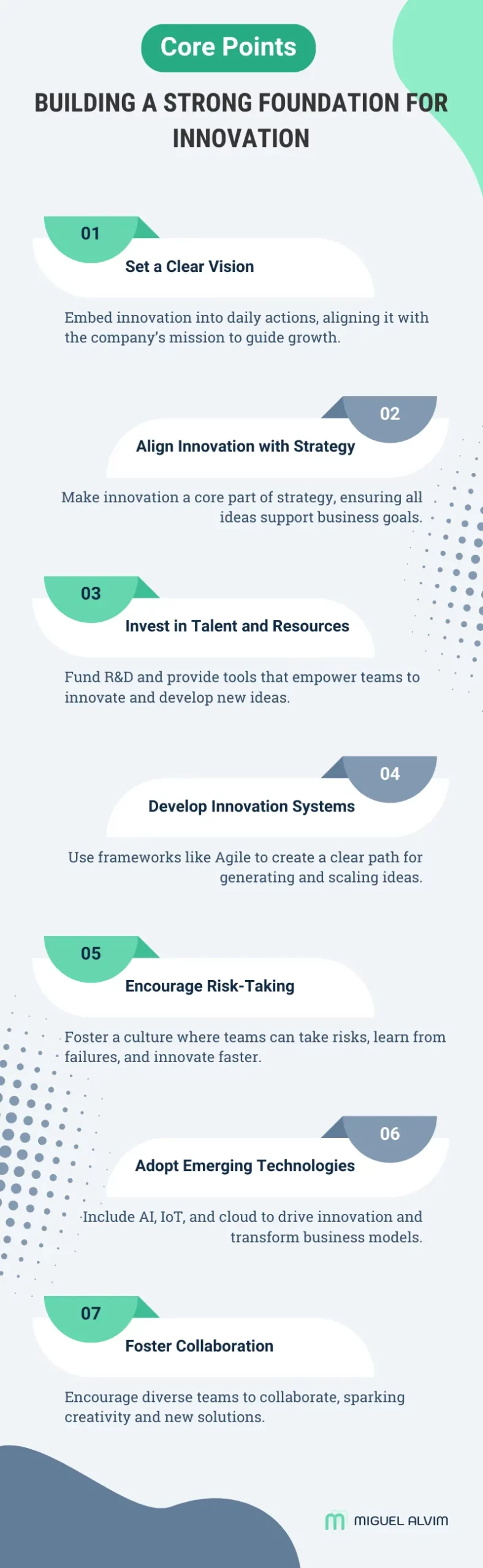
Core Points: Building a Strong Foundation for Innovation
Building an innovation-driven culture is not a one-time effort. It requires a clear focus on several foundational elements that align with the company’s strategic goals. What are the key areas to consider?
- Set a Clear Vision: A compelling vision for innovation aligns with the company’s mission and goals. This isn't only about having a vision statement; it's about embedding innovation into daily practices and decisions across all levels.
- Align Innovation with Strategy: Innovation should not be an isolated initiative. Make it a core part of the business strategy. Ensure that every innovative idea supports broader organizational goals, creating a cohesive effort that drives growth.
- Invest in Talent and Resources: People are at the heart of innovation. Allocate specific budgets for R&D, training, and innovation labs. Empower teams with the right tools and resources to experiment and bring new ideas to life.
- Develop Robust Innovation Systems: Innovation needs structure. Implement frameworks like Open Innovation or Agile methodologies. These provide a roadmap for generating, testing, and scaling new ideas effectively.
- Encourage Calculated Risk-Taking: Innovation comes with uncertainty. Leaders must create a safe environment where teams can take risks, learn from failures, and iterate quickly. "Fail fast, learn faster" should be the mantra.
- Leverage Emerging Technologies: Are you ready to integrate cutting-edge technologies? AI, IoT, and cloud computing are not just buzzwords; they are catalysts for innovation. Adopt them to drive meaningful change in products and processes.
- Foster Collaboration and Cross-Functional Teams: Break down silos and encourage teams from different departments to collaborate. When diverse perspectives meet, innovation flourishes. Create spaces—both physical and virtual—where this can happen.
Each of these core points lays the groundwork for a thriving innovation culture. By focusing on these fundamentals, senior IT leaders can drive sustainable growth and position their organizations as leaders in the market.
Now, let's explore the details more thoroughly…
What is an Innovation-Driven Culture and Why It Should Matter to Companies
Imagine a company where every employee feels empowered to suggest bold new ideas—where a software developer collaborates with a marketing strategist to brainstorm the next big product, and the leadership team actively encourages taking calculated risks. In this environment, failures aren't feared but embraced as learning opportunities. This is the essence of an innovation-driven culture: a workplace where creativity, collaboration, and continuous improvement are embedded into the organization's DNA.
An innovation-driven culture isn't merely about having a few brainstorming sessions or setting up an innovation lab. It’s about creating a dynamic ecosystem where every level of the organization is aligned with a shared goal: to challenge the status quo and drive meaningful change. Companies like Netflix, for instance, have leveraged such a culture to rapidly pivot and stay ahead of industry shifts, using data-driven insights and an experimental mindset to deliver groundbreaking content.
Why should this matter to your company? Because in today's fast-paced market, standing still is equivalent to moving backward. Research conducted by McKinsey in 2019 showed that companies with strong innovation cultures are 2.4 times more likely to achieve above-average growth compared to those that do not. An environment that encourages experimentation, values diverse perspectives, and prioritizes learning over perfection positions itself to seize new opportunities faster and outperform its competitors.
For senior IT leaders, cultivating this culture means more than implementing the latest technology. It requires a deliberate effort to build systems, processes, and mindsets that foster collaboration and creative problem-solving. It’s about moving from a “why” mentality to a “why not?” mentality—enabling teams to think big, act boldly, and innovate continuously.
By adopting these principles, organizations can build resilience, drive sustainable growth, and create a future-ready enterprise that thrives in the face of uncertainty.
Current Landscape and Evolution
In recent years, the pace of technological change has accelerated dramatically, transforming the way organizations approach innovation. The rise of digital transformation, Artificial Intelligence (AI), Machine Learning (ML), Internet of Things (IoT), and agile methodologies has fundamentally reshaped innovation strategies across industries.
This evolving landscape presents both challenges and opportunities for companies to innovate faster and more efficiently like:
- Digital Transformation as a Catalyst for Innovation: Digital transformation drives innovation by reshaping business models and enhancing customer experiences. Organizations that leverage AI and automation can gain deeper insights and adapt quickly to market changes. For instance, companies like Amazon and Microsoft have harnessed cloud computing and data analytics to transform their offerings and deliver unparalleled value to customers.
- AI and Automation: The adoption of AI and automation is further revolutionizing innovation strategies. AI-driven insights are enabling organizations to predict market trends, understand customer needs more deeply, and personalize offerings at scale. According to Gartner, by 2026, AI will have a significant impact on 80% of emerging technologies, underscoring the importance of integrating AI into innovation efforts.
- Agile Methodologies Driving Rapid Innovation: Agile practices, originally developed for software development, have now become essential across all types of innovation projects. The Manifesto for Agile Software Development focus on iterative progress, customer collaboration, and responsiveness to change has made it an ideal framework for organizations looking to stay competitive in fast-paced markets. Companies like Spotify and Tesla have adopted agile principles to create flexible and adaptive cultures that thrive on constant change.
- Urgency to Adapt: In this rapidly evolving landscape, the urgency for companies to adapt is more pressing than ever. The risks of standing still are high: businesses that fail to innovate risk losing relevance, market share, and even survival. As illustrated by the decline of companies like Nokia, failing to keep pace with technological advancements and market dynamics can lead to significant consequences.
Fostering an innovation-driven culture is not only about leveraging the latest tools and technologies but also about creating an organizational mindset that embraces change, values creativity, and is always ready to evolve.
Innovation-Driven Culture at the Individual Level
While organizational strategies and leadership play pivotal roles in fostering an innovation-driven culture, the true foundation lies in the collective efforts of individuals within the organization. It is the employees, at every level, who translate strategic vision into actionable innovation. For a culture of innovation to thrive, each individual must be empowered, equipped, and encouraged to think creatively, take risks, and continuously learn.
This section explores the essential role individuals play, the skills and mindsets required for fostering innovation, and the importance of continuous education and upskilling.
The Role of Individuals in an Innovative Organization
Innovation begins with individuals. Picture a product development team at a leading tech firm facing a critical challenge: how to deliver a breakthrough feature in record time. It takes more than just technical skills; it requires creativity, adaptability, and collaboration.
Creativity and Problem-Solving: Consider Julia, a UX designer at a startup, who noticed that users were struggling with the onboarding process. Instead of waiting for a directive, she took the initiative to redesign it, incorporating gamification. Her solution not only improved user retention but also set a new standard within her team.
Adaptability and Resilience: When COVID-19 hit, many companies had to pivot quickly. A small marketing team at a mid-sized company saw their plans fall apart overnight. Rather than panic, they adapted, launching a digital campaign that capitalized on the surge in online engagement. Their ability to pivot quickly turned a potential setback into a major win.
Collaboration and Communication: Innovation rarely happens in isolation. A team at Spotify faced a challenge in aligning their diverse perspectives on a new feature. They set up cross-functional "Innovation Sprints" where developers, marketers, and designers could freely pitch ideas and build on each other’s strengths. The result? A more user-centric product that boosted engagement by 40%.
Growth Mindset and Risk-Taking: Leaders should encourage a growth mindset, where failures are seen as opportunities. At Google, for example, the "X" team, responsible for "moonshot" projects, embraces risk. This mindset allowed them to pivot from projects like Google Glass and learn valuable lessons that informed future innovations, such as autonomous driving and renewable energy initiatives.
By fostering these skills and mindsets, senior IT leaders can empower their teams to think boldly and act decisively. An innovation-driven culture at the individual level is about more than just skills—it’s about nurturing an environment where every team member feels empowered to innovate.
Education's Role
Continuous education and upskilling are critical in maintaining an innovation-driven culture. As the pace of technological change accelerates, the need for a skilled and adaptable workforce becomes even more pressing. Back in 2020, the World Economic Forum already stated that over 50% of all employees will need reskilling by 2025 due to the rapid evolution of technology. Therefore, organizations must prioritize education and learning as key components of their innovation strategy.
There are several practical ways that leaders can encourage continuous learning and development:
- Workshops and Hackathons: These interactive, hands-on sessions allow employees to solve problems creatively and collaboratively. Hackathons, for example, provide a platform for rapid prototyping and ideation, enabling teams to work on innovative projects in a condensed timeframe. Organizations like Amazon and Facebook regularly use hackathons to encourage employees to develop new ideas and solutions beyond their daily work responsibilities.
- Innovation Bootcamps: Structured boot camps focused on innovation methodologies—such as Design Thinking, Lean Startup, and Agile—provide employees with the tools and frameworks needed to drive innovation. These programs help teams learn how to approach problems from multiple perspectives and develop viable solutions.
- Certifications and Formal Education Programs: Encouraging employees to pursue certifications in innovation management, data science, and other emerging fields can significantly enhance their ability to contribute to the organization’s innovation efforts. Partnerships with leading educational institutions can offer tailored programs that align with the organization’s strategic objectives. For example, companies like Google have established partnerships with universities to provide advanced courses in AI and machine learning for their employees.
- Learning Platforms and Communities: Digital platforms like Coursera, Udacity, and LinkedIn Learning offer a wealth of courses that employees can use to stay updated on the latest trends and skills. Building internal learning communities where employees share insights, resources, and experiences can further enhance a culture of continuous learning.
By investing in education and providing diverse learning opportunities, organizations can build a workforce that is not only capable but also motivated to drive innovation. Continuous learning ensures that employees remain adaptable, resilient, and ready to contribute to the organization’s growth in a rapidly changing world.
Strategies for Fostering Innovation
An innovation-driven culture isn't created overnight; it requires intentional strategies that focus on both external and internal dynamics. Here’s a breakdown of actionable strategies for strategic decision-makers to consider.
Customer-Centric and Market-Driven Innovation
To drive meaningful innovation, senior leaders must align their efforts with the needs of their customers and the dynamics of the market. This involves adopting a mindset that places the customer at the core of every decision and being agile in responding to technological and market shifts.
Customer-Centric Approach:
Understanding customer needs, behaviors, and pain points is fundamental. Executive leaders should leverage tools like Market Research, Customer Feedback Loops, and Customer Journey Mapping to gather actionable insights. For instance, customer journey mapping helps visualize the customer experience from initial contact through to post-purchase, identifying pain points and opportunities for innovation.
Platforms like Qualtrics and Medallia offer robust tools for capturing and analyzing customer feedback in real time. Leaders can drive innovation by incorporating this feedback into the development cycle, ensuring products and services remain relevant and compelling.
For example, Nike By You from Nike (previously "NikeiD") uses customer customization options to gather data on consumer preferences, feeding this back into product innovation.

Keep Up with Technology and Market Trends:
Staying abreast of technological advancements and market trends is crucial. Leadership team should foster a mindset of continuous learning within their teams by encouraging participation in industry conferences, subscribing to trend analysis platforms like CB Insights and Gartner, and leveraging Artificial Intelligence (AI) tools to analyze market shifts.
For example, Airbnb and Uber disrupted their respective industries by recognizing early on the potential of the sharing economy and quickly adapting their business models. Leaders should prioritize innovation efforts that align with these emerging trends, ensuring their organizations are not just reacting but proactively shaping the future.
Cultural Foundations for Innovation
Innovation flourishes in a culture where creativity, collaboration, and risk-taking are encouraged as mentioned earlier. Organizational leaders must actively cultivate an environment where employees feel safe to express ideas, experiment, and challenge the status quo using:
- Open and Inclusive Culture: To build an innovative organization, leaders must create a culture that values diverse perspectives and sees failure as a learning opportunity. This involves promoting psychological safety, where employees feel secure to share bold ideas without fear of criticism. Implement regular innovation forums or hackathons to encourage idea-sharing across all levels of the organization. Encourage a fail-fast, learn-fast mentality to normalize learning from mistakes and pivoting quickly. For example, companies like Pixar foster an inclusive culture by having daily "dailies" meetings where anyone can provide feedback, ensuring diverse voices are heard.
- Cross-Disciplinary Teams: Innovation often occurs at the intersection of different disciplines. Senior leaders should form cross-disciplinary teams that bring together diverse skill sets, such as marketing, engineering, and design. This promotes creative problem-solving by leveraging varied expertise. Use frameworks like the Double Diamond approach from Design Council, which promotes discovery and collaboration, to guide these teams in their innovation efforts.
- Diverse Perspectives: Actively seeking diverse perspectives across gender, race, age, and experience enriches the innovation process. Leaders should focus on inclusive hiring practices and create platforms for underrepresented voices within the company. Establish Employee Resource Groups (ERGs) and Diversity and Inclusion Councils to ensure a broad spectrum of ideas influences innovation initiatives.
- Freedom to Explore: Creativity thrives when employees have the freedom to explore their passions. Leaders can encourage this by providing “20% time” (like Google) or “innovation sabbaticals” for employees to work on personal projects that align with the company’s strategic goals. Additionally, implementing internal startup incubators can help develop new ideas without the usual operational constraints.
Resource Allocation and Support Structures
Innovation needs structure and resources to thrive. Leadership team must ensure their organizations are equipped with the necessary support, infrastructure, and clear directives like:
- Resources and Support: Innovation requires more than just good ideas; it requires time, funding, and mentorship. Leaders should allocate dedicated budgets for innovation projects and establish Innovation Labs or Centers of Excellence to provide a structured environment for testing new ideas. For example, Microsoft transformed itself by strategically investing in cloud infrastructure and creating a culture of continuous learning and experimentation. By allocating substantial resources to its Azure division and promoting a "learn-it-all" culture, Microsoft empowered its teams to innovate, experiment, and scale new technologies rapidly.
- Collaborative Spaces: Physical and virtual spaces that facilitate spontaneous interaction are critical for fostering collaboration. Consider redesigning office layouts to include collaboration zones or investing in digital collaboration tools like Miro and Slack to enable remote teams to brainstorm and innovate effectively.
- Innovation Metrics and Recognition: To sustain momentum, it’s vital to measure innovation efforts and recognize achievements. Define clear Key Performance Indicators (KPIs) such as the number of new ideas generated, time to market, and revenue from new products. Recognition programs, such as “Innovator of the Month,” can motivate teams and reinforce a culture of continuous improvement.
- Clear Goals and Strategies: While creativity is essential, innovation should be purposeful and aligned with the organization’s strategic objectives. Senior leaders should define a clear innovation strategy roadmap that outlines goals, timelines, and expected outcomes. Tools like Roadmunk and Aha! can help visually communicate these strategies across teams.
Experimentation and Adaptation
An innovation-driven culture is agile and responsive. It thrives on continuous iteration, learning, and ethical considerations:
- Prototype, Test, and Adapt: Leaders should foster a culture that embraces rapid prototyping and testing to validate new ideas quickly. Encourage teams to run A/B tests or pilot programs to gather early feedback and make necessary adjustments before full-scale implementation. Amazon, for instance, uses a “Working Backwards” approach, starting with a press release outlining customer benefits and iterating from there.
- Continuous Learning and Adaptation: Encourage teams to learn from both successes and failures. Implement retrospectives after every project to capture lessons learned and adjust strategies. Incorporate Learning Management Systems (LMS) to provide ongoing training and development.
- Ethical Innovation and Corporate Responsibility: Encourage teams to develop solutions that are socially responsible, environmentally sustainable, and economically viable. Leaders should integrate Ethics Committees into the innovation process to ensure alignment with Corporate Social Responsibility (CSR) goals. Companies like Patagonia have embedded sustainability into their innovation strategies, showing that ethics can drive innovation.
Strategic Partnerships and Funding
Strategic collaborations and robust funding strategies are essential for scaling innovation and expanding capabilities. Consider:
- Explore Strategic Partnerships: Identify and establish partnerships with external organizations, such as startups, universities, and research institutions. Such collaborations can provide access to new technologies, skills, and markets. For instance, Apple’s partnership with Nike led to the Nike+ app, combining expertise in sportswear and technology.
- Funding and Financial Strategies for Innovation: Develop a multi-tiered funding strategy that aligns with your innovation goals. Consider a mix of internal funding, venture capital, and public grants to support different types of innovation initiatives. Intel’s innovation fund, which invests in emerging technologies and startups, is an excellent example of how a strategic financial approach can support innovation while offering returns on investment.
Frameworks for Managing Innovation
Innovation frameworks provide structured approaches to guide innovation efforts within their organizations. Here are the most relevant frameworks, with practical applications for leaders.
Open Innovation
Coined by Henry Chesbrough, Open Innovation promotes the use of both internal and external ideas and paths to market. It encourages organizations to leverage external sources such as customers, partners, academia, and even competitors to enhance their innovation processes.
Practical Application: Executive leaders can implement Open Innovation by creating Innovation Ecosystems—networks of external partners that collaborate on research and development. This approach is used by companies like Procter & Gamble through their "Connect + Develop" program, which sources 50% of its innovations externally. Leaders can foster such ecosystems by setting up innovation hubs or hosting hackathons with external stakeholders.
Best Practices: Create structured collaboration models, set up IP (Intellectual Property) agreements, and define clear innovation goals to ensure partnerships are fruitful.
Design Thinking
Design Thinking is a user-centered approach that emphasizes empathy, ideation, prototyping, and testing. It encourages cross-functional collaboration and iterative problem-solving to develop innovative solutions that align closely with customer needs.
Practical Application: Leaders can embed Design Thinking into their organizations by training teams in the methodology and encouraging its use in product development and service design. SAP and IBM have successfully implemented Design Thinking workshops to drive customer-centric innovation. Leaders can establish innovation labs where cross-disciplinary teams use Design Thinking to tackle complex challenges.
Best Practices: Start with small-scale projects to demonstrate value, provide continuous training, and foster a culture where teams feel safe to fail and learn.
Lean Startup
Popularized by Eric Ries, the Lean Startup methodology focuses on building a Minimum Viable Product (MVP), testing assumptions, gathering user feedback, and iterating quickly. It’s aimed at reducing the risk of failure by validating ideas early in the development process.
Practical Application: Senior leaders can apply Lean Startup principles to accelerate innovation by setting up innovation teams that operate like startups within the company. For example, GE’s FastWorks program uses Lean Startup principles to rapidly develop new products and services. Leaders can create innovation sprints or incubators to test new ideas in a controlled environment.
Best Practices: Encourage a culture of experimentation, establish rapid feedback loops, and iterate quickly based on customer data.
Agile Methodologies (Scrum, Kanban, XP)
Agile methodologies prioritize flexibility, iterative development, and customer feedback. Scrum and Kanban are popular frameworks within Agile that promote short development cycles (sprints) and visual management of work.
Practical Application: Companies can drive Agile transformation by setting up cross-functional Agile teams that work on specific innovation projects. For example, Spotify’s "Squad" model uses Agile practices to deliver continuous innovation. Leaders should focus on creating an environment that supports rapid iteration and collaboration.
Best Practices: Implement regular retrospectives to learn from each iteration, invest in Agile coaching, and provide autonomy to teams to drive innovation.
Stage-Gate Process
The Stage-Gate Process divides the innovation process into distinct stages, each separated by a “gate” where decisions are made on whether to proceed, pivot, or halt a project. This approach is widely used in product development, particularly in industries like pharmaceuticals.
Practical Application: Leaders can use the Stage-Gate model to manage large-scale innovation projects, ensuring that risks are identified and mitigated early. For example, Pfizer uses Stage-Gate to manage its complex drug development pipeline. Leaders can integrate Stage-Gate with Agile practices for greater flexibility.
Best Practices: Customize the number and criteria of gates based on project complexity, ensure cross-functional representation at each gate review, and use data-driven decision-making.
Business Model Innovation (BMI) and Business Model Canvas (BMC)
Business Model Innovation (BMI) and Business Model Canvas (BMC) help organizations rethink and innovate their business models by visualizing key elements such as value propositions, customer segments, revenue streams, and cost structures.
Practical Application: Companies can utilize the Business Model Canvas to facilitate strategic discussions about potential changes or adaptations to the company’s current business model. For instance, Airbnb used Business Model Innovation to disrupt the hospitality industry by creating a new marketplace.
Best Practices: Use the BMC to map out various scenarios, involve cross-functional teams in the process, and focus on customer-centric value propositions.
Jobs-to-be-Done (JTBD) Theory
JTBD focuses on understanding the underlying "jobs" that customers are trying to accomplish and innovating around those needs. It offers a framework for uncovering unmet needs and designing products and services to meet them.
Practical Application: Senior leaders can implement JTBD by conducting customer interviews and ethnographic studies to understand customer pain points and desired outcomes. Intercom uses JTBD to inform its product development and customer support strategies.
Best Practices: Develop a structured JTBD framework, incorporate findings into product roadmaps, and continuously refine offerings based on customer feedback.
Blue Ocean Strategy
Blue Ocean Strategy encourages companies to create uncontested market spaces ("blue oceans") rather than competing in existing saturated markets ("red oceans").
Practical Application: Leaders can apply Blue Ocean Strategy by conducting a strategic canvas to identify the key factors that define competition in their industry and then look for ways to eliminate, reduce, raise, or create different elements. Cirque du Soleil applied this strategy to reinvent the circus industry.
Best Practices: Use Blue Ocean tools like the Strategy Canvas and Four Actions Framework to identify opportunities, encourage out-of-the-box thinking, and avoid getting stuck in red oceans.
Tools for Managing and Measuring Innovation
Choosing the right tools for managing and measuring innovation is crucial for aligning efforts with an organization’s size, industry, and specific goals. Here are the key categories of tools that leaders should consider.
Idea Management Tools
These tools help organizations capture, evaluate, and prioritize ideas from employees, customers, and partners.
Tools:
- IdeaScale: Crowdsources ideas and manages them through different development stages.
- Brightidea: Offers tools for idea management, innovation challenges, and portfolio management.
- Spigit (by Planview): Provides idea crowdsourcing and innovation management for large enterprises.
How to Choose: Select based on the organization’s size and complexity of innovation processes. For larger enterprises, tools like Spigit offer more sophisticated features like integration with existing enterprise systems.
Collaboration and Co-Creation Platforms
Facilitate collaboration among teams, both physically and virtually, and enable co-creation with external partners.
Tools:
- Miro: An online collaborative whiteboard platform that supports brainstorming and design thinking workshops.
- MURAL: Similar to Miro, it provides templates and a collaborative environment for remote ideation.
How to Choose: Consider factors like team size, remote work capabilities, and the level of interaction needed for ideation sessions.
Innovation Portfolio Management Tools
Help in managing a portfolio of innovation projects, aligning them with strategic goals, and ensuring resource allocation is optimized.
Tools:
- Planview: Offers comprehensive tools for strategic planning, portfolio management, and resource optimization.
- Sopheon (Accolade): Manages the entire innovation lifecycle from idea generation to product launch.
How to Choose: Evaluate based on the organization’s need for integration with other business systems, such as ERP or CRM, and the level of detail required for portfolio tracking.
Design Thinking and Prototyping Tools
Facilitate rapid prototyping and testing, enabling teams to iterate quickly based on user feedback.
Tools:
- Figma: A collaborative interface design tool that allows real-time feedback and iteration.
- InVision: Supports digital product design, prototyping, and user feedback.
- Marvel: A user-friendly platform for prototyping, wireframing, and user testing with collaborative features for design teams.
- MindMeister: A mind mapping tool that facilitates brainstorming, idea organization, and collaborative planning in real-time.
- Smaply: A journey mapping tool that helps visualize customer experiences, stakeholder maps, and personas for effective design thinking.
- Ideaflip: An intuitive tool for brainstorming sessions, capturing ideas, and fostering team collaboration in a virtual space.
How to Choose:
- For comprehensive interface design and real-time collaboration, Figma is ideal for medium to large teams that require an all-in-one solution for designing, prototyping, and gathering feedback. Its cloud-based platform enhances collaboration and streamlines design processes.
- If your focus is on creating interactive prototypes and gathering user feedback with a strong emphasis on design iteration, InVision is a solid choice. It suits teams of any size looking for a platform to facilitate user-centered design and product development.
- For teams that need a simpler, more accessible tool for creating wireframes and quick prototypes with seamless team collaboration, Marvel provides an easy-to-use interface and is well-suited for small to medium-sized companies or those new to design prototyping.
- If your organization values ideation and collaborative brainstorming in the early stages of design thinking, MindMeister is an excellent tool. It's best for teams of any size that need to map out ideas, organize thoughts, and plan collaboratively in real-time.
- When understanding and mapping customer journeys are critical to your design thinking process, Smaply is ideal. It’s particularly useful for service designers, UX teams, or consultants who focus on visualizing complex customer experiences and aligning stakeholders.
- For organizations that prefer a lightweight tool for remote brainstorming sessions and idea capturing, Ideaflip is a great choice. It’s most effective for small to medium-sized teams looking to foster creative collaboration in a virtual space.
Open Innovation Platforms
Connect organizations with a global network of solvers to crowdsource solutions for R&D challenges.
Tools:
- InnoCentive: Leverages a global community to solve technical and scientific challenges.
- NineSigma: Helps engage with external innovators for open innovation projects.
How to Choose: Evaluate based on the organization’s specific needs for external collaboration and the complexity of the problems to be solved.
Trend Analysis and Market Intelligence Tools
These tools provide data-driven insights on emerging technologies, market trends, competitive landscape, and investment patterns, enabling companies to stay ahead of the curve.
Tools:
- CB Insights: Offers comprehensive data on venture capital, startups, patents, and emerging technology trends, helping organizations make informed decisions on innovation strategies.
- Quid: Analyzes large volumes of unstructured data to identify emerging trends, competitive threats, and innovation opportunities.
How to Choose: Depending on the level of detail required, consider the tool’s ability to integrate with internal data sources and provide predictive analytics to inform strategic decisions.
Agile Project Management Tools
Facilitate the management of innovation projects by enabling agile practices such as sprint planning, task management, and real-time collaboration.
Tools:
- JIRA by Atlassian: Widely used for Agile project management, particularly in software development, it supports continuous delivery and iterative product development.
- Trello: A simpler, Kanban-based project management tool that helps teams visualize workflows and manage projects effectively.
- Taiga: This is an open-source project management tool for cross-functional agile teams to work effectively.
How to Choose: For large organizations with complex projects, JIRA offers robust features and integrations. Smaller teams or simpler projects may benefit more from Trello’s user-friendly interface or Taiga.
Innovation Metrics and Assessment Tools
Tools that help organizations measure and assess their innovation capabilities, track progress, and benchmark against industry standards.
Tools:
- Innovation 360 (InnoSurvey): Provides innovation assessments and benchmarking tools that help companies understand their innovation capabilities and identify areas for improvement.
- InnovationCast: Focuses on tracking innovation culture, measuring innovation metrics, and ensuring strategic alignment.
How to Choose: Select a tool that aligns with your organization’s innovation goals, whether it’s benchmarking performance, assessing cultural readiness, or tracking ROI on innovation projects.
Rapid Prototyping and Development Tools
These tools support rapid prototyping, allowing teams to quickly build and test new concepts before scaling them up.
Tools:
- Arduino: An open-source electronics platform that allows rapid prototyping and testing of hardware solutions.
- 3D Printing Software (e.g., Tinkercad, Fusion 360): Enables rapid prototyping of physical products, fostering an experimental approach to innovation.
How to Choose: The choice depends on the type of product being developed. For software and digital products, tools like InVision or Figma may be more suitable, while for hardware, tools like Arduino or Fusion 360 provide more specialized capabilities.
Innovation Strategy and Roadmapping Tools
Help organizations create visual roadmaps for planning and communicating their innovation strategies across teams.
Tools:
- Roadmunk: Assists in creating visual roadmaps to align teams around innovation strategies and communicate the vision.
- Aha!: A comprehensive tool for product and innovation planning, idea prioritization, and feature management.
- ProductPlan: A visual roadmap platform that helps teams plan, communicate, and collaborate on product strategy and prioritize initiatives.
- Airtable: A flexible collaboration tool that combines spreadsheets and databases, enabling teams to manage roadmaps, track projects, and plan innovation workflows.
- ProductBoard: A customer-centric product management tool for prioritizing features, gathering feedback, and aligning roadmaps with strategic goals.
How to Choose:
- For large enterprises needing comprehensive planning and detailed feature management, Aha! is ideal due to its extensive functionality for product strategy, idea prioritization, and detailed roadmapping.
- If your organization is medium to large-sized and requires a visually appealing way to align teams around innovation strategies with easy-to-understand roadmaps, Roadmunk is a great option, offering user-friendly interfaces and robust collaboration features.
- For smaller to medium-sized companies or startups that prefer a more visual, straightforward approach to roadmap planning, ProductPlan is a great choice. Its intuitive drag-and-drop interface and straightforward pricing make it accessible.
- When flexibility and customization are key, and the need for a combination of databases and project tracking tools exists, Airtable stands out. It's suitable for teams of any size that need a flexible, cost-effective solution to manage roadmaps and track innovation workflows.
- If your team is focused on customer-centric product management and values a tool that integrates well with customer feedback and aligns roadmaps with strategic goals, ProductBoard is the right choice. It's particularly effective for mid-sized companies looking to balance customer insights with strategic planning.
- For detailed strategy development and communication, Aha! is ideal due to its robust feature set. For simpler, more visual-focused road mapping, Roadmunk offers a user-friendly solution.
Building an Innovation Leadership Mindset
Leadership isn't just about strategy; it's about vision. To drive innovation, leaders must embody a mindset that inspires others to think creatively, take risks, and push boundaries. This mindset is built on four essential pillars:
- Invest in Innovation: Leaders who invest in innovation do more than allocate budgets—they prioritize creating environments where creativity thrives. For example, Satya Nadella's leadership at Microsoft involved significant investment in cloud technology and fostering a "learn-it-all" culture. This shift empowered teams to experiment, leading to transformative products like Azure and Microsoft Teams.
- Develop Innovation Systems: An effective innovation mindset requires structured systems. Innovation needs frameworks like Agile or Lean Startup to channel creativity into results. Procter & Gamble (P&G), for instance, uses its "Connect + Develop" open innovation model to streamline collaborations and bring external ideas to market faster. This system has enabled P&G to continuously innovate while reducing time to market.
- Scale Technology Innovation: Technology is the engine of modern innovation. Leaders must not only adopt new technologies but integrate them strategically. Consider how Amazon Web Services (AWS) scaled its cloud solutions from an internal tool to a global leader in cloud computing by understanding customer needs and relentlessly iterating on its offerings. Scaling technology isn't just about deployment; it’s about creating value.
- Evolve Next-Generation Enterprise Systems: A leadership mindset focused on innovation looks ahead. It's not just about what's working now but anticipating future needs and challenges. Netflix's pivot from DVD rentals to streaming and, later, original content creation exemplifies this. By evolving its core systems, Netflix has remained agile, adapting to changing consumer behaviors and market dynamics.
Each of these pillars requires a leadership approach that combines vision with action. By integrating these principles, senior IT leaders can build a culture where innovation isn't just encouraged—it's expected and achieved.
Success Case Studies
Successful companies often excel in embedding innovation into their core values and strategies. Let’s explore three companies that have effectively applied the principles discussed earlier—Investing in Innovation, Developing Innovation Systems, Scaling Technology, and Evolving Enterprise Systems—to build robust innovation cultures.
3M: A Culture of Innovation and Collaboration
3M is renowned for its culture of innovation, driven by a "15% rule" that allows employees to dedicate 15% of their time to projects of their choice. This autonomy encourages experimentation and has led to breakthrough products such as Post-it Notes and Scotch Tape. The company's emphasis on cross-functional collaboration and a decentralized R&D model empowers employees to innovate at all levels.
What Worked Well:
- Empowerment and Autonomy: By giving employees the freedom to explore their ideas, 3M fosters a culture of creativity and ownership. This encourages risk-taking and drives continuous innovation.
- Cross-Functional Collaboration: Encouraging collaboration across departments ensures that diverse perspectives contribute to innovation, leading to more comprehensive and well-rounded solutions.
Results Achieved: 3M has consistently been ranked as one of the most innovative companies globally, with its products spanning multiple industries and markets. The company's commitment to innovation has resulted in a steady stream of new products and sustained competitive advantage.
Actionable Insights: Organizations can replicate 3M’s success by fostering a culture that promotes autonomy, cross-functional collaboration, and dedicated time for innovation. Consider implementing policies similar to the "15% rule" to give teams the freedom to experiment and innovate.
Source: Harvard Business Review
Netflix: Data-Driven Personalization and a Culture of Experimentation
Netflix, originally a DVD rental service, has transformed into a global leader in streaming entertainment by leveraging data-driven personalization, continuous experimentation, and a culture of freedom and responsibility. This strategic focus on innovation has enabled Netflix to disrupt traditional entertainment models and maintain its competitive edge.

What Worked Well:
- Data-Driven Decision Making: Netflix excels in using advanced data analytics and machine learning algorithms to deliver highly personalized content recommendations, significantly enhancing user engagement and retention.
- Culture of Experimentation: The company promotes a culture of experimentation through A/B testing and agile methodologies, allowing rapid adaptation and iteration of new features and functionalities based on user feedback.
- Empowerment through Autonomy: Netflix's "Freedom and Responsibility" culture empowers employees to take risks and explore new ideas, fostering an environment where innovation thrives across all levels.
Results Achieved: By combining data-driven insights with a culture of experimentation, Netflix has achieved significant success in original content creation, such as Stranger Things and The Crown, and maintained high customer satisfaction and loyalty. The company’s continuous innovation strategy has positioned it as a leader in the entertainment industry.
Actionable Insights: Companies should consider leveraging data and analytics to drive personalized user experiences and promote a culture of experimentation. Encouraging autonomy and providing the tools and freedom for teams to innovate can lead to breakthrough ideas and sustained competitive advantage.
Source: Psychology Today
Procter & Gamble (P&G): Open Innovation with 'Connect + Develop'
P&G's "Connect + Develop" strategy focuses on sourcing half of its innovations from external partners such as startups, universities, and even competitors. This open innovation model has helped P&G diversify its product portfolio and reduce time-to-market.

What Worked Well:
- Leveraging External Expertise: By partnering with external innovators, P&G taps into a broader pool of ideas and technologies that complement its internal capabilities.
- Structured Open Innovation Framework: P&G’s systematic approach to managing partnerships, intellectual property, and integration of external ideas helps streamline innovation processes.
Results Achieved: P&G has successfully launched numerous products through external collaborations, including the Swiffer and Crest White Strips, which became billion-dollar brands.
Actionable Insights: Leadership Team should consider adopting open innovation models, particularly in industries where collaboration can accelerate innovation. Setting up dedicated teams to manage external partnerships and streamline integration can help maximize the benefits.
Source: IOP Science
Failure Case Studies
Success stories inspire, while failure cases reveal critical pitfalls, both offering valuable lessons for shaping effective innovation strategies. Understanding these missteps can help leaders avoid similar mistakes and refine their own innovation strategies. Below you can see three companies that struggled to innovate effectively and connect their experiences to the core principles discussed.
Kodak: Failure to Adapt to Digital Innovation
Kodak, once a leader in photography, failed to transition to the digital era despite inventing the first digital camera. The company’s fear of cannibalizing its profitable film business led to its downfall, as it did not fully embrace digital innovation. Currently, Kodak appears to have learned from its past mistakes and is actively engaging with emerging technologies like blockchain and cryptocurrency.

What Went Wrong:
- Resistance to Disruptive Innovation: Kodak's leadership was too focused on protecting its existing film business, which prevented it from capitalizing on digital technology.
- Lack of Strategic Alignment: There was a disconnect between Kodak’s innovation efforts and its overall strategic goals, leading to half-hearted attempts to innovate.
Lessons Learned: Companies must be willing to disrupt their own business models to stay relevant. Leaders should align innovation efforts with strategic goals and not shy away from pursuing disruptive technologies, even if it means short-term sacrifices.
Actionable Insights: Senior leaders must foster a culture where disruptive innovation is encouraged, even if it threatens existing revenue streams. Regularly revisiting strategic goals to align them with technological trends can help avoid Kodak’s fate.
Source: The CDO Times
Nokia: Missed Opportunities in Smartphone Innovation
Nokia was a dominant player in the mobile phone market but failed to transition effectively to the smartphone era. Its hierarchical culture, coupled with a reluctance to move away from its outdated Symbian operating system, led to its decline.

What Went Wrong:
- Siloed and Rigid Culture: Nokia’s organizational structure was highly siloed, preventing collaboration and rapid decision-making.
- Fear of Failure and Risk Aversion: A conservative approach to innovation meant that Nokia was slow to respond to market changes, such as the rise of iOS and Android.
Lessons Learned: Innovation requires agility and a willingness to experiment. Leaders should encourage a culture that promotes risk-taking and agility, enabling the organization to adapt to rapid technological changes.
Actionable Insights: Companies should break down silos and encourage cross-functional collaboration to foster agility. Regular market assessments and a willingness to pivot strategies are essential to remain competitive.
Source: Knowledge
Sears: Failure to Innovate Beyond Traditional Retail Models
Sears, once a retail giant, failed to innovate its business model in response to the rise of e-commerce. The company’s resistance to change, coupled with outdated technology and a lack of a clear innovation strategy, led to its downfall.

What Went Wrong:
- Inability to Adapt Business Models: Sears continued to rely on its traditional retail model and failed to pivot to digital, missing out on the e-commerce boom.
- Lack of Vision and Leadership in Innovation: Without a clear vision for innovation, Sears’ efforts were fragmented, reactive, and ultimately ineffective.
Lessons Learned: Companies must constantly innovate their business models and embrace digital transformation. Leadership must have a clear vision and commitment to drive innovation across all levels of the organization.
Actionable Insights: Leadership team should prioritize digital transformation and be willing to rethink traditional business models. Developing a forward-looking innovation strategy that aligns with technological trends is critical for sustained success.
Source: Cleo
Wrapping Up
Driving innovation is no longer a choice; it’s an imperative. In today's fast-evolving market, an innovation-driven culture can mean the difference between leading and lagging. By investing in innovation, fostering a mindset that embraces risk, and developing systems that support continuous growth, organizations position themselves to thrive amidst uncertainty.
Senior IT leaders must take decisive steps to embed these principles into their organizations. The time to act is now—prioritize innovation, empower your teams, and build a future-ready company capable of adapting to whatever comes next.