In today’s digital-first economy, IT is no longer just a support function; it is the engine driving business growth. Without a high-performing IT department, companies risk falling behind. But how do IT executives bridge the gap between strategy and execution to drive innovation and efficiency?
This article provides IT leaders with a roadmap to align IT strategy with business goals and structure teams for success.

Let’s start with the fundamentals: aligning IT with the broader business strategy...
Aligning IT with Business Strategy
A high-performing IT department doesn’t operate in isolation; its success hinges on how well it aligns with the overall business strategy. The most effective IT leaders understand that their department is not just a support function, but a critical driver of business outcomes.
For IT to function better, the business side of the company has to get more involved.
McKinsey
Why Alignment Matters
When IT and business strategies are aligned, IT becomes a catalyst for growth, enabling the company to adapt quickly to market changes, improve operational efficiency, and deliver better customer experiences. Conversely, a misaligned IT department can slow down progress, waste resources, and create friction between teams.
Practical Steps for Alignment
Here’s how leaders can ensure alignment:
- Engage with C-Level Executives: Make IT a central part of strategic discussions. Collaborate with the CEO, CFO, and other key executives to understand top priorities, such as scaling operations or entering new markets.
- Translate Business Goals into IT Projects: Break strategic objectives into actionable IT initiatives. If customer retention is a goal, IT could focus on deploying CRM tools for personalized interactions.
- Create an IT Roadmap Aligned with Business Outcomes: Develop a roadmap that outlines how IT will contribute to growth through technology investments and infrastructure upgrades, measured by KPIs such as time-to-market for new products.
Real-World Example: Netflix’s Strategic Alignment with IT
One company that successfully aligned IT with business strategy is Netflix. As the company evolved from a DVD rental service to a global leader in streaming, IT was instrumental in driving this transformation. The shift to a digital-first business model required the IT department to work hand-in-hand with leadership to ensure scalability, performance, and a seamless user experience.
Netflix’s IT team implemented a cloud-based infrastructure early on, migrating to Amazon Web Services (AWS) to scale operations and support its growing global audience. This strategic alignment allowed Netflix to:
- Handle large-scale streaming demands globally with minimal downtime.
- Deploy new features quickly, such as personalized content recommendations powered by data analytics.
- Drive innovation through continuous integration and delivery, enhancing both customer experience and competitive advantage.
By tightly aligning IT with business goals—such as ensuring global content delivery and scaling operations efficiently—Netflix’s IT department was a key enabler of the company’s success.

Common Pitfalls to Avoid
When IT and business strategies are not aligned, organizations often face several challenges:
- Wasted Resources: A misaligned IT department can result in costly investments in technology that doesn’t directly support business objectives. For example, investing in an expensive data center when cloud adoption is a key business goal can lead to sunk costs and inefficiencies. A well-known example of wasted resources due to misalignment is the Concorde project.
- Slowed Innovation: Without alignment, IT becomes reactive instead of proactive, only responding to business demands rather than driving innovation. This can prevent the organization from capitalizing on new technologies and staying competitive. Companies that fail to align IT with their innovation goals often lag behind industry disruptors.
- Organizational Friction: Misalignment creates disconnects between IT and other departments, leading to poor communication, unclear priorities, and delayed projects. For example, IT departments that focus solely on cost-cutting may miss opportunities to enhance customer experience or support new product initiatives, causing tension between business units. Sony’s failure to align IT with business strategy resulted in delays and missed opportunities, particularly in their digital media initiatives.
Is your IT team stimulating innovation or reacting to misalignment?
Key Takeaway
Alignment is an ongoing process. Schedule regular meetings with C-level executives to review and adjust your IT roadmap based on evolving business priorities. By committing to continuous collaboration, IT departments become value creators, driving innovation and efficiency.
Developing a Robust IT Strategy
Once IT and business strategies are aligned, the next step is to create a robust IT strategy that supports both the organization’s current needs and its future growth. A clear, well-defined IT strategy serves as the foundation for decision-making and resource allocation, helping IT teams stay focused on what matters most.
Here are some steps to help you develop a solid IT strategy:
- Define Key Objectives: Start by defining the core objectives for your IT department. These should directly support business goals but be specific to IT’s role. For example, your objectives could include enhancing data security, improving infrastructure resilience, or speeding up product development cycles.
- Prioritize Initiatives: Not every project will have the same impact, so prioritization is essential. Focus on initiatives that deliver the highest business value. This might include migrating legacy systems to the cloud for better scalability, automating routine tasks to free up resources, or adopting data analytics tools to provide deeper business insights.
- Plan for Scalability and Growth: An effective IT strategy is not only reactive but also proactive. Plan for scalability by incorporating emerging technologies like cloud computing and AI. This ensures your IT infrastructure can handle future growth without constant overhauls.
- Engage Stakeholders: Involve key stakeholders from across the business in the planning process. Their insights will help ensure that your IT strategy is comprehensive and aligned with the company’s broader needs. This also creates buy-in and support from other departments, making execution smoother.
- Develop a Detailed Roadmap: Translate your strategy into a clear, actionable roadmap. This roadmap should outline timelines, budget requirements, and key performance indicators (KPIs). Ensure that the roadmap is flexible enough to adjust as business needs evolve but structured enough to guide daily operations.
Key Challenges to Avoid
While building an IT strategy, certain pitfalls can undermine success. Avoid these common challenges to ensure your strategy remains effective:
- Overcomplicating the Strategy: Simplicity is key. Overly complex strategies can confuse teams and lead to poor execution. To avoid this, break down your strategy into clear, digestible steps and ensure that each initiative ties directly back to the company’s objectives.
- Underestimating Technology Costs: New technologies often come with hidden costs like maintenance, integration, and training. Avoid budget overruns by thoroughly evaluating both upfront and long-term costs for each technology you plan to implement. Always allocate a contingency budget for unexpected expenses.
- Lack of Flexibility: Rigid strategies can become obsolete quickly in a rapidly changing tech landscape. Ensure your IT strategy is adaptable by incorporating periodic reviews and making room for adjustments as new technologies and business needs arise.
- Ignoring Stakeholder Input: Neglecting to involve key stakeholders can lead to a misalignment between IT initiatives and business needs. Keep communication channels open and actively seek input from different departments to ensure your strategy is both comprehensive and aligned.
- Neglecting Risk Management: Every IT strategy should include a risk management plan. Ignoring potential risks—such as cybersecurity threats or vendor dependency—can lead to significant setbacks. Build a robust risk assessment into your strategy from the start.
Key Takeaway
A robust IT strategy is the blueprint for success, but it must be simple, flexible, and risk-aware. Avoid common challenges by keeping the strategy aligned with business goals, managing technology costs, and incorporating feedback from stakeholders. With careful planning, your IT department can position itself to drive business growth while preparing for future challenges.
Structuring the IT Team for Success
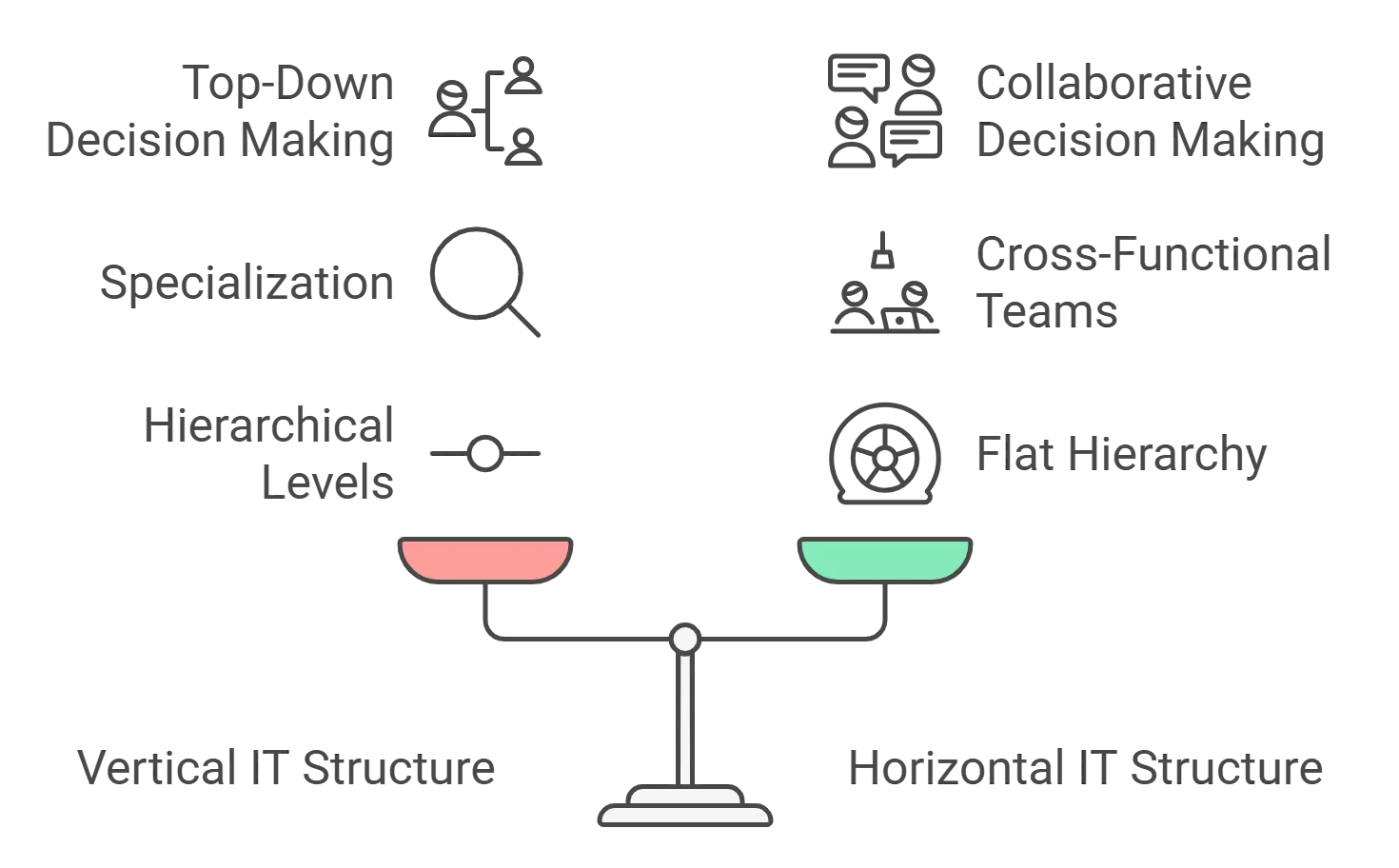
A well-structured IT team is the backbone of a high-performing IT department. It’s not just about having the right talent—it’s about organizing that talent in a way that maximizes efficiency, fosters collaboration, and ensures clear ownership of responsibilities. A properly aligned IT team can adapt quickly to new challenges, reduce bottlenecks, and ensure seamless delivery of services.
Key Roles and Functions
Every high-performing IT team requires a mix of specialized roles. The specific structure will depend on the size and complexity of your organization, but some critical roles include:
- Platform / Infrastructure Engineers: Responsible for designing, adding self-servicing capabilities and maintaining the backbone of your IT environment—networking, servers, and cloud infrastructure.
- Security Experts: Cybersecurity is non-negotiable in today’s threat landscape. You need dedicated roles that focus on protecting data and responding to security incidents.
- DevOps Engineers: These professionals bridge the gap between development and operations, enabling faster deployment and greater reliability through automation. While Platform Engineering focuses on infrastructure design and self-service capabilities, DevOps emphasizes in automation, continuous delivery, and the reduction of cognitive load to enhance productivity and software quality.
- Data Analysts and Engineers: With data driving decision-making, your IT department needs a team that can manage, analyze, and extract actionable insights from company data.
Optimizing Team Performance
A well-structured team is only effective when it works seamlessly together. Focus on:
- Clear Reporting Lines: Ensure everyone knows who they report to and what they’re responsible for. Ambiguity can lead to confusion and inefficiencies.
- Fostering Internal Collaboration: Encourage collaboration within the IT department through cross-functional teams. For instance, DevOps, security, and infrastructure teams should work closely to ensure system reliability and security.
- Agility in Roles: The IT landscape changes rapidly, and so should your team structure. Encourage skill development and make room for flexibility—cross-training team members in different areas will allow your department to adapt to changing needs without losing momentum.
Succession Planning for Long-Term Success
While structuring for today’s performance is critical, technology strategists must also focus on future-proofing their team. Succession planning is a key strategy for ensuring long-term success and stability within the IT department.
- Identify Future Leaders: Succession planning starts with identifying team members who demonstrate leadership potential. Look for those who consistently take initiative, show strategic thinking, and have a deep understanding of both technology and the business. These individuals are prime candidates for future leadership roles.
- Create Leadership Development Opportunities: To cultivate leadership skills, provide opportunities for high-potential employees to take on more responsibility. This could include leading cross-functional projects, mentoring junior staff, or representing the IT department in executive-level meetings. Encourage continuous learning by supporting certifications in leadership, project management, and emerging technologies.
- Cross-Training for Flexibility: Cross-training is not just about skill development—it’s also essential for succession planning. By ensuring that multiple team members can handle critical tasks, you reduce the risk of disruption when key leaders move on or when the department grows. This flexibility ensures operational continuity and positions the department to adapt quickly to new challenges.
- Establish a Mentorship Culture: Encouraging a mentorship culture is another effective way to prepare your team for leadership transitions. Pairing senior leaders with emerging talent can accelerate knowledge transfer and help future leaders develop the soft skills needed to manage teams and drive strategic initiatives.
Key Takeaway
Structuring your IT team for success requires more than optimizing for current performance. A well-structured IT team not only handles today’s challenges but also maximizes the value of technological investments. With a strong foundation in place, the next step is leveraging technology as an enabler of efficiency and growth..
Identifying future leaders, offering development opportunities, and creating a flexible team structure will help safeguard the long-term success and agility of your IT function.
Technology as an Enabler of IT Department Efficiency
Technology is a critical driver of IT efficiency and cost-effectiveness. By leveraging the right technologies, IT departments can streamline processes, optimize resource utilization, and deliver greater business value while keeping costs low. For IT executives, the key is to maximize ROI by ensuring every technology investment leads to measurable improvements in efficiency and cost savings.
Automation and Cloud Infrastructure
By utilizing automation and cloud infrastructure, tech teams can streamline processes and minimize resource expenditure. Automating routine tasks such as system monitoring and patch management optimizes resource use, while cloud platforms like AWS, Google Cloud and Azure provide flexible, scalable options, ensuring cost-effectiveness and improved productivity.
Automation and cloud infrastructure offer significant returns on investment by reducing manual workloads, minimizing downtime, and eliminating the need for costly hardware. By automating routine tasks, IT teams can focus on strategic initiatives that drive business growth. Cloud platforms further enhance ROI by enabling a shift from capital expenditures to operational expenses, allowing businesses to scale infrastructure up or down based on actual demand. This flexibility reduces waste and ensures cost alignment with business needs, resulting in optimized resource utilization.
Monitoring and Performance Management for Proactive Cost Control
Monitoring tools like Splunk and Nagios provide real-time insights into infrastructure and application performance, helping IT teams proactively identify and resolve issues. This reduces costly downtime and improves overall service delivery.
By preventing system failures and optimizing resource usage, monitoring tools help avoid the high costs of unplanned outages or system slowdowns. Investing in these tools leads to better capacity planning, reducing the need for emergency fixes that can drain resources and disrupt operations.
Enhancing Collaboration with Integrated Tools
Collaboration tools like Slack, Discord, Google Chat, MatterMost (open source) and Microsoft Teams not only improve communication within IT but also reduce the time spent on manual coordination and issue tracking. When integrated with IT service management tools, they streamline workflows, enhance transparency, and reduce inefficiencies.
Improved collaboration directly translates to higher productivity. By reducing time spent on manual communication and tracking, IT teams can focus on high-priority tasks that drive business value. Integrated tools also reduce the likelihood of miscommunication or duplicated efforts, which can lead to costly errors or delays.
Key Takeaway
Technology investments in automation, cloud infrastructure, monitoring, and collaboration tools can significantly enhance IT department efficiency while delivering measurable cost savings. By focusing on ROI and cost-effectiveness, leaders can ensure that every technology deployed maximizes business value, reduces operational overhead, and supports long-term growth.
With the right technologies in place, the next challenge is turning strategic plans into actionable results. This requires adopting execution frameworks that ensure consistent, measurable outcomes.
Executing the Strategy: Turning Plans into Results
Crafting a strong IT strategy is crucial, but the real challenge lies in execution. Turning strategic plans into measurable results requires adopting practical frameworks, tracking the right performance metrics, and proactively addressing common execution obstacles.
Execution Frameworks
Successful execution starts with choosing the right framework to guide your team’s work. Here are a few key frameworks that can help IT departments efficiently translate strategy into action:
- Agile for IT Operations: Agile helps IT teams break projects into manageable sprints, allowing for continuous feedback and adaptation. This approach is ideal for IT operations that require flexibility and responsiveness to changing business needs.
- DevOps for Continuous Integration/Delivery: DevOps bridges the gap between development and operations, enabling faster deployment cycles, continuous delivery, and quick iteration. By fostering collaboration across teams, DevOps accelerates the implementation of new features and services.
- ITIL for Service Management: ITIL (Information Technology Infrastructure Library) focuses on aligning IT services with business needs. It provides a framework for managing IT service delivery efficiently, emphasizing best practices for operational stability and improvement.
By selecting and adapting these frameworks based on your organization’s needs, you can ensure smoother project execution and better alignment with strategic goals.
Measuring Success
Execution without measurement lacks accountability. To ensure the IT strategy is delivering value, it’s essential to track specific performance metrics:
- System Uptime and Availability: Measure the reliability of your IT infrastructure. High uptime translates into uninterrupted business operations and enhanced user satisfaction.
- Incident Resolution Times: Monitor how quickly your team resolves incidents. Shorter resolution times improve service quality and minimize business disruptions.
- Operational Cost Savings: Regularly assess cost efficiencies achieved through automation, cloud adoption, or process improvements. This metric reflects the overall financial impact of your IT initiatives.
- Project Delivery Timelines: Track adherence to project schedules. Timely delivery demonstrates operational efficiency and effective resource management.
By setting clear KPIs in these areas, you ensure that your IT department remains focused on delivering tangible business outcomes.
Key Challenges and How to Overcome Them
Despite having the right frameworks and metrics, common challenges can derail execution. Here are some key obstacles and actionable strategies to mitigate them:
- Resource Constraints: Limited budgets and staffing can slow down execution. To mitigate this, prioritize high-impact initiatives that deliver immediate business value. Use automation and outsourcing where appropriate to extend your team’s capabilities without increasing headcount.
- Shifting Priorities: Business needs often evolve during the execution phase, making it difficult to stay on track. Agile methodologies can help your team pivot quickly by incorporating regular feedback loops and maintaining flexibility within projects.
- Cross-Departmental Misalignment: Miscommunication between IT and other departments can lead to delays and conflicting priorities. To overcome this, establish regular check-ins with stakeholders to ensure alignment and keep everyone informed of progress and potential changes.
Key Takeaway
Executing an IT strategy requires more than just planning—it demands the right frameworks, performance measurement, and proactive problem-solving. By adopting Agile, DevOps, or ITIL frameworks, tracking key performance metrics, and addressing common challenges head-on, senior IT leaders can turn strategic vision into measurable business results.
Continuous Improvement: Measuring and Optimizing IT Department Performance
Continuous improvement is the key to sustaining long-term IT department success. By regularly measuring performance and optimizing operations, IT executives can ensure their departments remain efficient, agile, and aligned with business goals.
Key Performance Metrics
Tracking the right KPIs enables IT leaders to assess the effectiveness of their operations and identify areas for improvement. Essential metrics include:
- Mean Time to Recovery (MTTR): Measures how quickly your team restores service after an incident, directly impacting system reliability and business continuity.
- Infrastructure Cost Management: Evaluate how effectively resources are being utilized. Cloud optimization tools can help reduce unnecessary spend while maintaining scalability.
- Software Delivery Velocity: Track the speed at which new features or fixes are deployed, indicating how quickly your department can respond to business needs.
Optimization Tips
To continuously optimize IT performance, focus on the following strategies:
- Leverage Data Analytics: Use predictive analytics to anticipate system failures, proactively addressing issues before they disrupt operations. Tools that analyze usage patterns or log data can reveal inefficiencies that may otherwise go unnoticed.
- Automate Repetitive Tasks: Automation reduces human error and frees up resources for strategic projects. Automated backups, system patches, and monitoring tools ensure seamless operations without constant manual intervention.
- Optimize Resource Allocation: Use tools like AIOps to allocate resources dynamically, ensuring optimal performance without over-provisioning. This approach helps balance costs with service quality.
Practical Frameworks: Continuous Service Improvement (CSI)
To maintain high performance, adopt a Continuous Service Improvement (CSI) approach, as outlined in the ITIL framework. CSI involves regularly assessing IT service delivery, identifying areas for enhancement, and implementing incremental improvements. By integrating CSI into your department’s culture, you foster a mindset of constant growth and efficiency.
Key Takeaway
For IT departments to remain competitive, leaders must embrace continuous improvement through regular KPI monitoring, strategic optimization, and frameworks like CSI. By leveraging analytics, automation, and dynamic resource allocation, IT executives can ensure their departments are not only efficient today but ready for future challenges.
Looking Ahead: Preparing for Future IT Challenges
The IT scenery is rapidly evolving, with emerging technologies and shifting business models creating both opportunities and challenges. Senior IT leaders must be proactive in preparing for these changes by leveraging advanced technology and cultivating the right talent to ensure sustained success.
Anticipating Emerging Technologies
Staying ahead requires a commitment to adopting cutting-edge technologies such as AI, machine learning, and automation. These tools can revolutionize business processes, enabling IT teams to deliver greater value while reducing operational costs. However, the challenge lies not just in adopting these technologies but in integrating them effectively within the organization.
- Artificial Intelligence (AI) and Automation: AI is rapidly changing the way businesses operate, from predictive analytics to automated customer service solutions. IT leaders should be prepared to invest in AI-driven infrastructure and tools that enhance decision-making and operational efficiency.
- Edge Computing: As businesses move toward decentralized infrastructures, IT departments must be equipped to manage distributed data processing and real-time analytics.
- Cybersecurity: With the growing threat landscape, investing in robust cybersecurity measures is essential. IT leaders must ensure that their teams are well-versed in the latest security protocols and technologies.
Talent Management for the Future
Preparing for future IT challenges isn’t just about technology; it’s about building the right team. IT leaders must invest in upskilling and reskilling their teams to handle emerging challenges effectively.
Key Focus Areas for Talent Development:
- AI and Automation Experts: As AI and automation become integral to IT operations, having a team proficient in these technologies is critical. IT leadership should prioritize hiring or training specialists who can implement and manage AI-driven solutions.
- Cloud and DevOps Skills: As businesses continue to adopt cloud solutions and agile methodologies like DevOps, teams must be capable of deploying, managing, and optimizing these infrastructures. technology leaders should focus on building a team with strong cloud and DevOps expertise.
- Cybersecurity Specialists: With cyber threats evolving, IT departments must have skilled cybersecurity professionals who can safeguard critical business systems and data.
Investing in continuous learning is vital to keep teams up to date with the latest technologies. Create pathways for employees to pursue certifications, attend workshops, or participate in cross-functional projects that enhance their technical and leadership skills. By fostering a culture of learning and innovation, IT leaders can future-proof their departments.
Key Takeaway
Preparing for future IT challenges requires both technology adoption and investing in talent. Technology strategists must strike a balance between implementing new technologies like AI and edge computing and developing a workforce skilled in these areas. A future-ready IT department is built on continuous learning, adaptability, and strong leadership.
Conclusion
Building a strong IT department is key to business success today. It’s not just about having the right technology. You need the right team and a clear strategy.
This is a journey that takes ongoing effort and adjustments. Start by reviewing your strategy and making sure it matches your business goals. Empower your team, use the best tools, and stay flexible.
The challenges ahead are real, but so are the rewards. Now is the time to put your plan into action.